We are seeing good progress on dune regeneration at Nairn Central Beach
The latest update from Mark Bradfield our Coordinator is posted below – you’ll see from the photos how community efforts have made a very visible difference already……
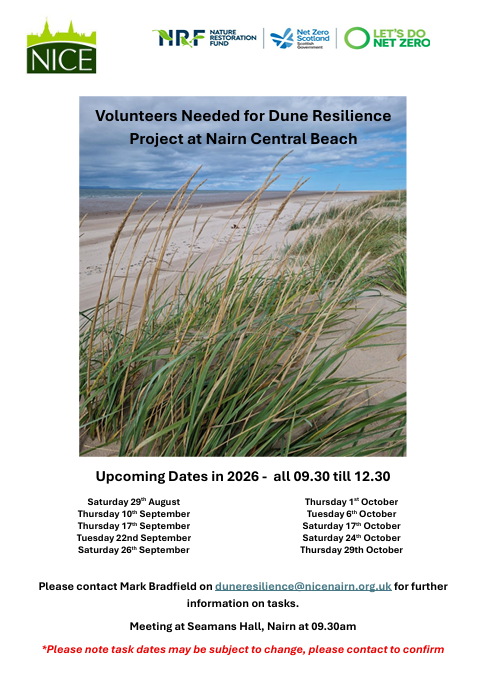
More workdays are planned through September and October to clear scrub and replant marram grass. Please come along and help if you can to make sure that our dunes are in good shape to withstand the next winter’s storms.
Email duneresilience@nicenairn.org.uk to sign up to one or two of these morning sessions
Dunes Update September 2026
It is almost a year since we started the practical element of the Dune Resilience Project on Nairn dunes Central Beach. Our first volunteer work party was on Saturday 27th September 2025 and we started planting marram grass on the 23rd October 2025.
The project has been monitoring the pilot area since planting, and we were pleased to see the newly planted marram grass was not ripped out or killed off by winter storms and that the fencing installed to protect it was respected and well received by most.
Monitoring carried out in early September 2026 indicate some key positives:
- Areas with >50% bare ground have reduced from 29% to 20%
- Areas with kidney vetch or birds foot trefoil present have increased from 3% to 13%
- Over 90% of the marram grass planted has taken successfully
- Sand build up has been slower than anticipated
Fixed point photography has also been helpful in documenting the recovery
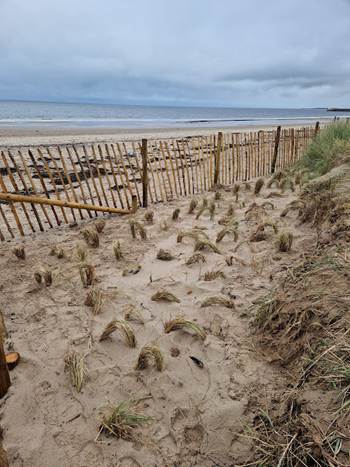
November 2025 – newly planted marram grass
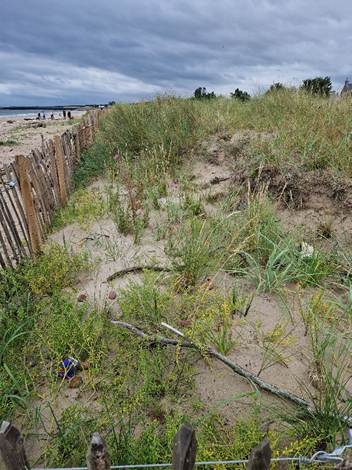
August 2026 – green shoots of recovery!
This shows clearly that the chosen measures taken have worked and that the pilot area is starting to recover – but the evidence also illustrates that recovery is slow. The guidance stated that it can take 2 years for newly planted marram to become established and that fencing was needed to protect it in this phase. Hopefully in another years’ time the newly planted marram will have formed nice healthy clumps able to trap sand and start rebuilding the dune.
Its evident from the photos that the fencing and reduction in footfall has allowed other plant species to get a foothold such as the sea rocket visible in the foreground. But recovery hasn’t taken place just inside the fencing – lyme grass, marram grass and sea rocket immediately in front of the fencing has also increased as you can see from these photos below
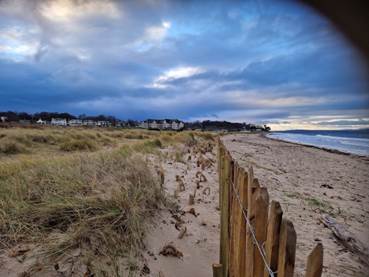
Western end of pilot area -Nov 2025
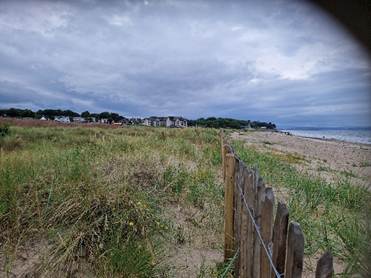
Same area in July 2026
We believe this is down to the lack of footfall through this area in front of the fencing and the slight sand build up in this accretion zone. Lyme grass is the main species present – this is more salt tolerant than marram grass so fares better in front of the foredune and is another very beneficial species in dune recovery.
It is also good to see the increase in birds foot trefoil and kidney vetch within the pilot plot and there were some good patches of kidney vetch in other areas of the dunes this year. These are both very important species for the rare small blue butterfly which did have a very good year in 2026. During the joint event with Butterfly Conservation held on June 17th every person that came along got to see at least 1 small blue butterfly in the dunes which was a real treat!
Both species of plant are also important for other pollinators and we managed to identify 6 species of bumblebee and 6 species of butterfly in the dunes during 2026.
In terms of general recovery in the pilot area, what were once bare paths or very trampled areas through the pilot area are now starting to recover due to the reduced footfall, but again, this recovery is slow. This is probably due to the fact the sand is very compacted in these areas. It would be useful to repeat the drone flyover at some point to be able to compare images.
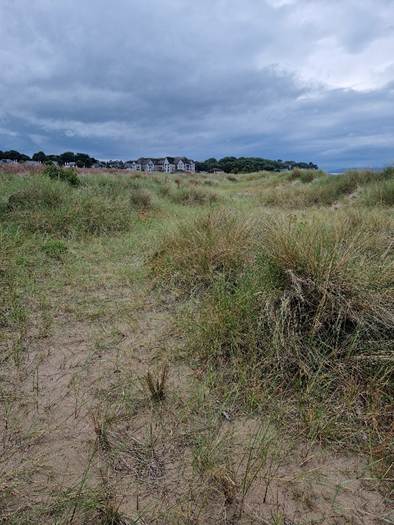
Marram recovering on trampled paths- July 2026
The monitoring has also shown that rosebay willowherb is becoming an increasing problem, particularly in the pilot area but with large numbers of plants appearing in other area to the East. We will be discussing this issue further with Nairn Common Good officer and Trustees as intervention is needed by grounds staff or a contractor. Regrowth of trees that were cut off at ground level has, as expected, become an issue. Either annual maintenance to remove regrowth or targeted application of a biocide is needed to remedy this although current Common Good guidance prohibits use of biocide.
Going Forward
We are keen to replicate the methods used in the pilot project on the next section of dunes and have chosen an area to the East of the pilot area for Phase 2(towards the Sundancer) Some reduction of scrub (mostly broom) and invasive plants has already taken place and we are now in a position to begin translocating marram grass into eroded sections. A series of 10 volunteer work parties have been scheduled between now and end of October. We have budget to install additional fencing and will agree the location with Common Good Trustees at the earliest opportunity so that it can be in place to protect newly planted marram grass. We are keen to work further with the people of Nairn to help protect the dunes at Central Beach – a beautiful and important asset for both climate adaptation and biodiversity.
Mark Bradfield, NICE Dune Resilience Coordinator – Sept 2026.
More information on this project can be found on the Dune Resilience page